Thinking like an artist for better mental health
Part 1: Seeing things as they are, not as we think they are
As I write this, it’s raining heavily in Calgary, and the city is on edge.
Ever since the massive 2013 flood, whenever the mountain snow starts to melt, and seasonal rain causes the rivers to rise, the city’s anxiety rises with it.
It’s understandable. The 2013 event—the biggest flood the city had experienced since 1897—caused an estimated $6 billion in damages. It flooded entire neighbourhoods along the Bow and Elbow Rivers and put city landmarks like the Saddledome and Stampede Grounds under water.
So potent is that collective memory that I found myself being influenced by it when we arrived in Calgary in 2018. Many of my neighbours saw the flood first-hand and were a part of the recovery efforts, so as the years went by, I found their anxiety being passed on to me.
Helpful vs unhelpful anxiety
Our imagination is a powerful tool because it allows us to take information that we have available to us and use it to predict outcomes. Now, because our minds are heavily wired for survival, our minds tend to use that information to predict negative outcomes, so that we can avoid them.
For instance, ever since my thigh bone fracture and lengthy hospital stay, I’ve paid close attention to my anxiety as I have continued through my rehab and recovery. While I might get frustrated at my inability to do some task that I could do before, my anxiety reminds me to be cautious.
My genetic condition makes my bones brittle. My broken thigh bone healed wonky. Is it worth the risk, or should I take those extra few minutes to find a safer option?
Similarly, when the river starts to rise, and the city sends out flood or weather alerts to residents, heeding those warnings is simply the smart thing to do. Today is not the day for a leisurely paddle down the river.
The problem comes when our imaginations begin to elaborate on the information that has been provided, and the mind generates an outsized level of anxiety based on these predictions.
Using the artist’s eye to see what is true
As an artist, I have also found myself grappling with what my mind thinks it sees versus what is actually in front of me. Take this portrait that I completed when I was first learning acrylics.
Now, I love this painting, and it hangs above the couch in our living room. It’s beautiful and elegant, but it doesn’t look at all like the woman in the reference photo I was working from, and it doesn’t look like a “real” person.
At the time, I was struggling with what my mind thought a person looked like, particularly parts like the nose, lips and hands. No matter how many times I drew a face, those parts morphed into my mind’s interpretation as opposed to reality.
I decided to combat this tendency to interpret by doubling down on reality. I used the light table on my animation desk to trace 50 celebrity faces. I traced real noses, real lips, real hands… over and over and over again. The more faces I traced, the more I began to let go of the idea of a nose, and it became a collection of shapes that together formed a nose.
Learning to see with my eyes rather than my mind, is one of the most valuable lessons I’ve learned as an artist.
It greatly improved my artistic skills, (as you can see from this freehand digital painting that I finished after my fifty traced faces), and I’ve since learned to apply this way of thinking when I notice my anxiety creeping up as well.
Checking anxiety against reality
Imagine for a moment that your manager unexpectedly snaps at you at work. Yesterday, he was cheerful and chatty as you’ve come to expect, but today he’s closed off and short-tempered.
Anxiety interprets the available information as: “He’s mad at me. I must have done something wrong, and he’s going to fire me.”
But, is it true? Could something else have happened?
Perhaps he got some distressing health news. Perhaps his own boss said something rude to him. Perhaps there’s a conflict at home that has him distracted.
Instead of spinning off infinite scenarios, you could do a reality check.
“Hey, I noticed you don’t seem like yourself today. Is something wrong?”
He might very well say, “I didn’t appreciate how you wrote that report” and you’d have to deal with that.
He might also say something like, “Sorry, I found out that my kid is being picked on at school and I’m not handling well,” and recognize that he wasn’t being fair to you.
He might also brush it off and not say anything of note.
Regardless, doing a check against the reality of the situation can be incredibly helpful when it comes to separating unhelpful anxiety from helpful anxiety.
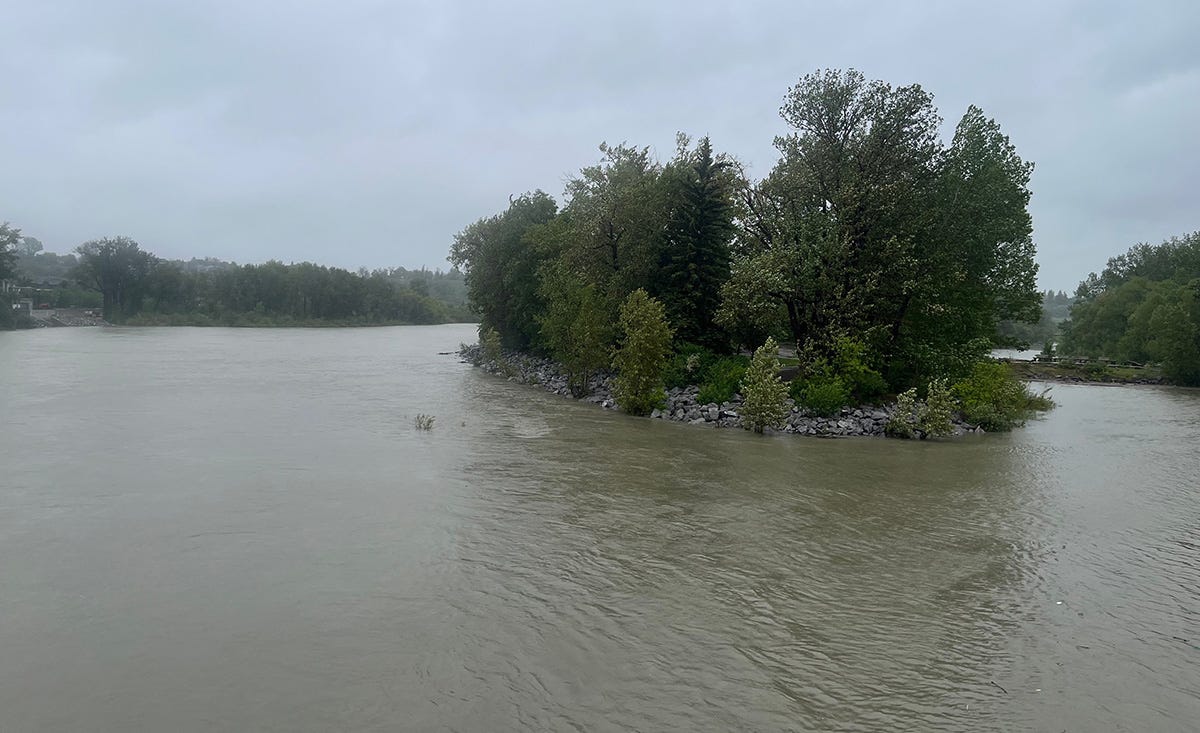
As for Calgary’s high-running river, I made a point of stepping out the door this morning in the pouring rain to check where the water levels were at.
The river isn’t at 2013 levels with the water almost touching the underside of the Peace Bridge.

It is running high, but still way below the bottom of the Peace Bridge.
Of course, there’s no guarantee that the water won’t keep rising as the rain continues. The situation could become more dangerous for Calgarians, or it could become a meteorological footnote and be forgotten in a week.
Helpful anxiety has a purpose because it keeps us prepared, but it’s always important not to let our minds flood us with negative hypothetical outcomes.
Athena is an artist, writer and creativity coach who believes that anyone can benefit from a healthy creative practice.


