

In my last article, “Creatively capturing a calm state of mind”, I wrote about how we need to be mindful of the memories that we immerse ourselves in when doing creative work.
But what happens when events unexpectedly attach themselves to the work?
“Rising Together” is a painting I began working on in late 2023 for my solo exhibition on love and disability. From the start, I always knew that it was going to be the painting that encapsulated the exhibit, so I gave myself lots of time and space to chip away at it.
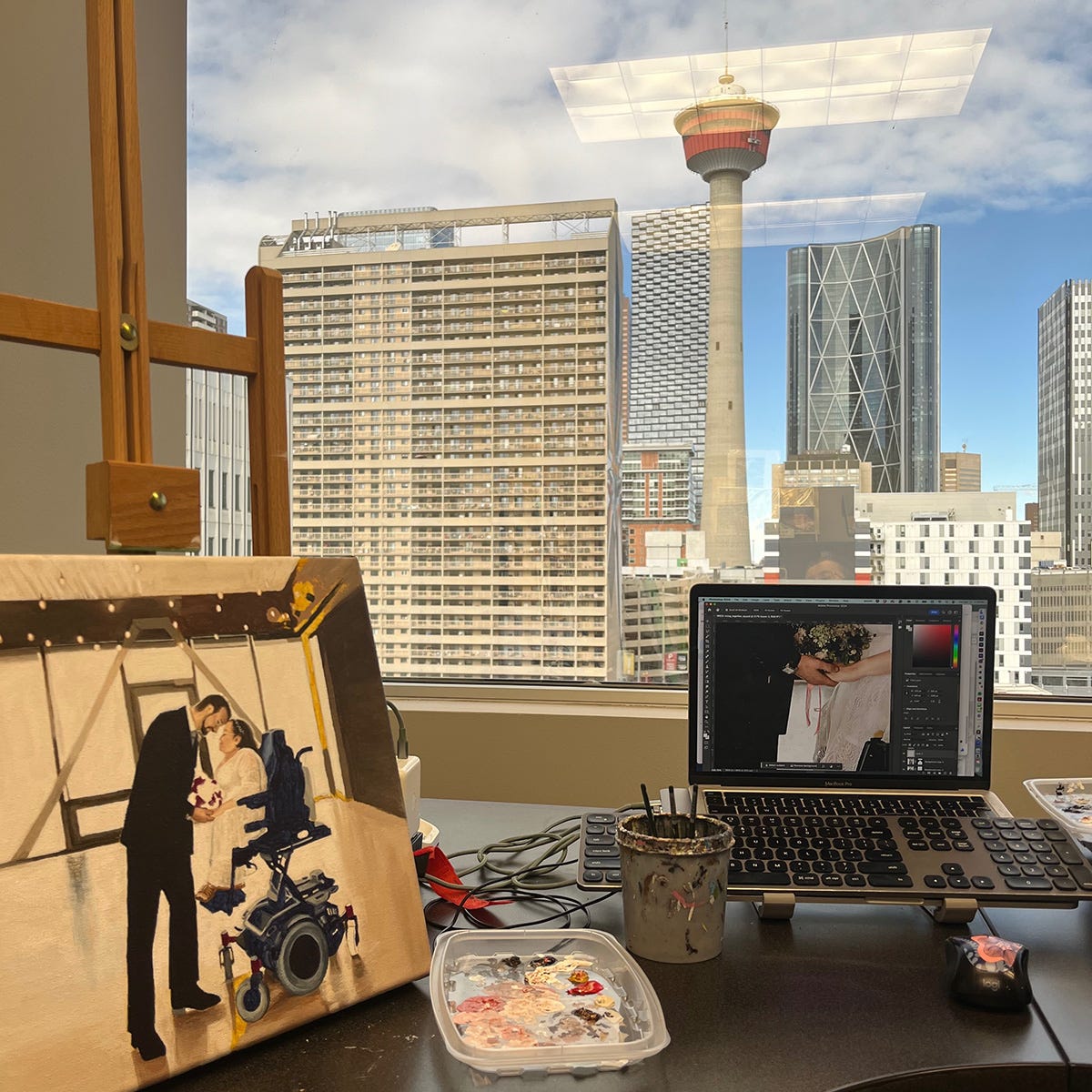
On March 12, 2024, I posted this photo to Instagram as I worked on the painting with the caption: “Sometimes I feel the need to remind myself that this is my job now. 🥰”
I was in my studio. I was working on a beautiful painting for my exhibit. I vividly remember feeling that all was right with the universe, which is why I took the photo to commemorate the moment.
Ten days later, I would be admitted to the hospital with a broken left thigh bone, and my whole world felt like it had been turned upside down.
New threads of meaning
“Rising Together” was always intended to be a meaningful painting. Our wedding photographer perfectly captured a beautiful romantic memory, but also the unusual reality of being an interabled couple.
Circumstances, however, added unintended, painful layers to the painting’s meaning.
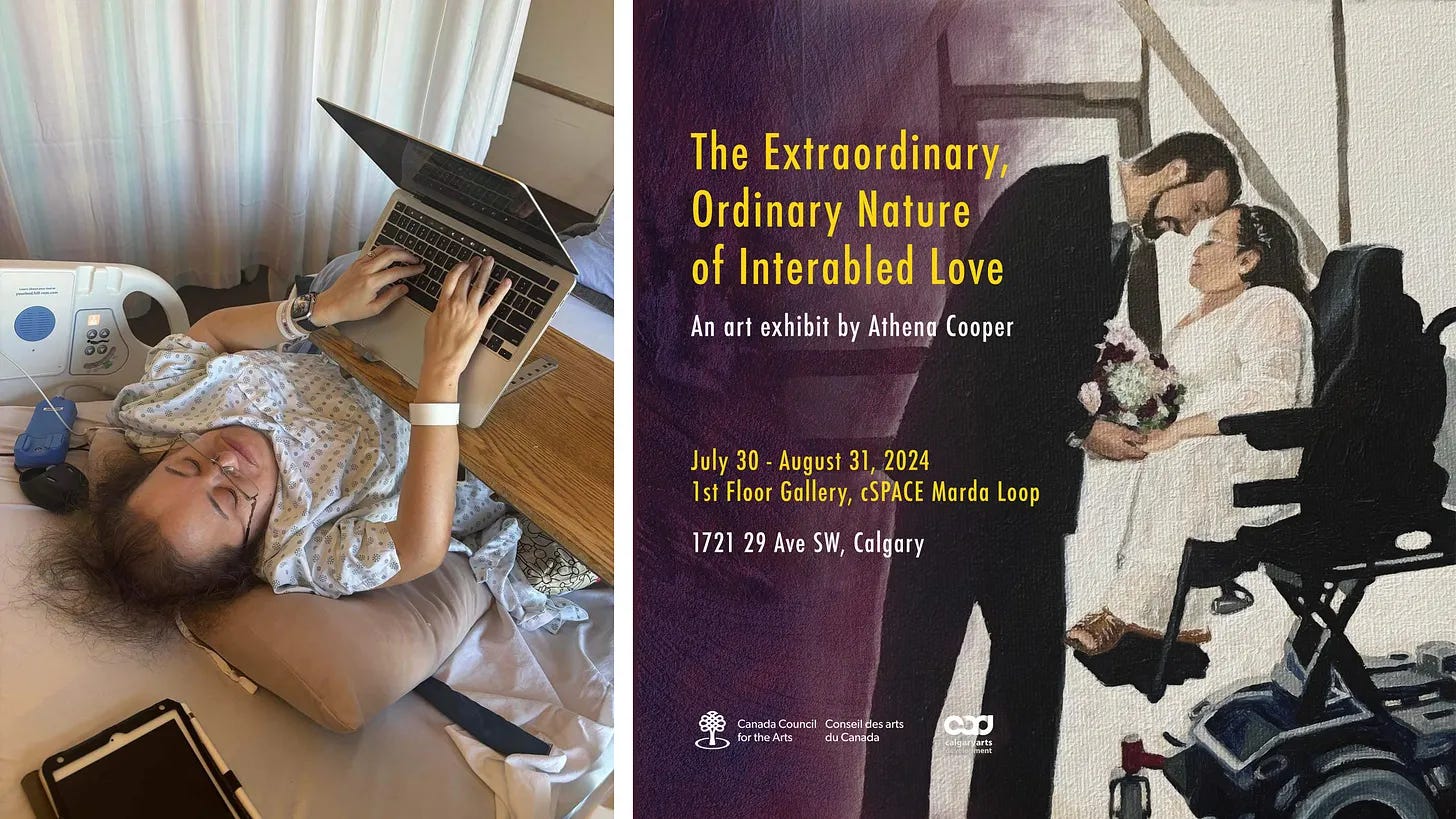
As I pressed onwards from my hospital bed, the painting was still the emotional and conceptual tentpole of the exhibit, but I spent a lot of time concealing its rougher, unfinished edges in my promotional materials. The August 2024 exhibit would ultimately include 11 mockups and unfinished paintings alongside the 33 finished pieces, but I still wanted the marketing to have a polished first impression.
The exhibit was a resounding success, but I still considered it a compromised version of my original vision.
Through the long months of my hospital stay and gruelling rehab, I promised myself that someday I would finish all the paintings and stage the exhibit as originally intended.
Of course, when I did finally get out of the hospital in January 2025, my focus was on clawing my way back to my previous level of functionality—or at least as close an approximation to it as I possibly could.
More time passed, and the finished and unfinished works from the exhibit remained packed in boxes at the studio.
Untangling for Tangled
When I was invited to be part of a group exhibition at Tangled Art + Disability in Toronto, I thought it would be just the push I needed to start working on those unfinished paintings from the exhibit again.
So, this past March, I committed “Rising Together” as one of the three paintings I would be sending for the September exhibit. I suspected that there would be resistance, but I figured I would have plenty of time to finish the painting.
I tried to break the process down into the smallest, most manageable steps possible:
Go through the exhibit boxes at the studio to find the painting
Bring the painting home and place it somewhere where I can see it
It was around this point that my desire to take slow, careful steps towards my goal turned into an elaborate dance of avoidance and procrastination.
I should find those missing paints and brushes that are buried somewhere in the studio.
I should finish the Lucy paint-by-number first, since the company did ask me before my agreement with Tangled.
I should start a new tiny painting as a warm-up and practice with my stay wet palette.
Realizing my excuses were getting increasingly ridiculous, and that I needed to send out “Rising Together” with the other paintings in less than a month, I finally buckled down this past long weekend.
I needed to start, but when I finally did, it was a painting session unlike any I’ve ever had before.
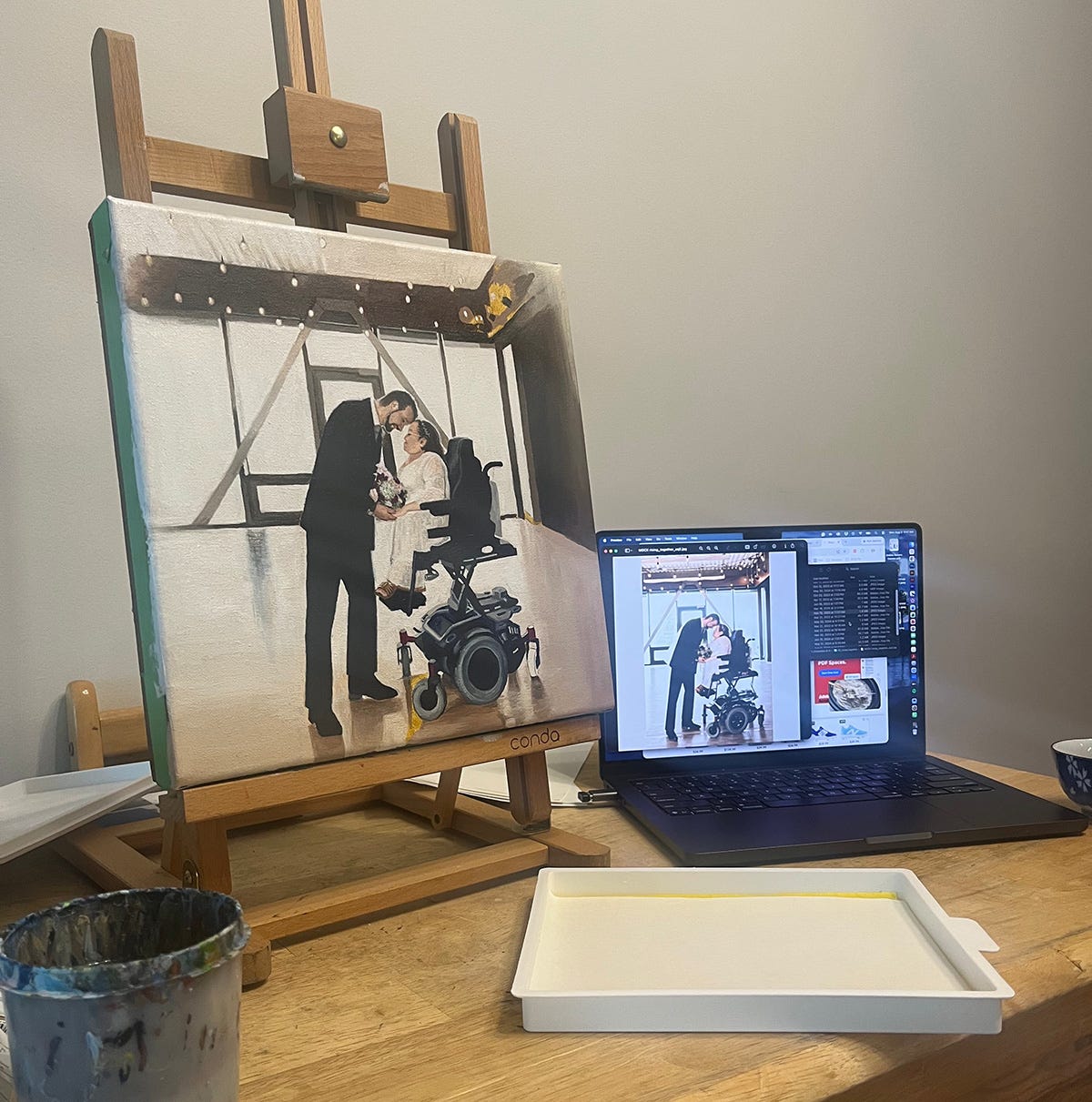
It began with tension as I laid out my materials. The tension grew as I chose an area to work on—one of those very obvious unfinished areas that I had cropped out in my promo materials at the hospital.
By the time I put brush to canvas, I was on the verge of tears, but I pushed forward. I began muttering to myself, “I don’t need to finish it. I just need to change it,” to remind myself that I didn’t need to finish it in this single session; I only needed to make progress.
When Stefan got back from walking the dog, I was a wreck. The dam burst, and I sobbed in his arms for a time.
Grief. Waves and waves of grief flowed over me.
I had told myself in the hospital that someday I would stage the exhibit with its original vision as I had intended. I realized, however, that I would never be able to turn back the clock in that way.
It had been over two years since I last worked on “Rising Together,” and I couldn’t remember what I had originally intended. More than that, I’d had experiences as an artist and a human that had changed how I painted. I’d done a half dozen different paint-by-numbers from my hospital bed. I’d learned to paint with oils and illustrated an entire children’s picture book using digital painting.
I was grieving the “innocent” person I was before my time in hospital.
I was grieving the “untainted” exhibit that hadn’t been shown before it was truly ready.
I was grieving the path I would never be able to take.
Healing one brushstroke at a time
As I continued to work on the painting, my roiling emotions gradually began to subside.
I recall the tension noticeably easing when I decided to paint tread on the wheelchair’s tire. I had a vague recollection of discussing the tire with my painting mentor during class when I first started the painting. Knowing him, he would have been firmly in the “less is more” camp and, knowing my love of detail, I would have been arguing for “more is more.”
I couldn’t remember how the discussion had been resolved, so I painted the suggestion of tread into the tire anyway.
My instinct that I needed to change the painting had been right, though. The closer I brought the painting to finished in the here and now, the less important the pre-hospital, hypothetical painting became.
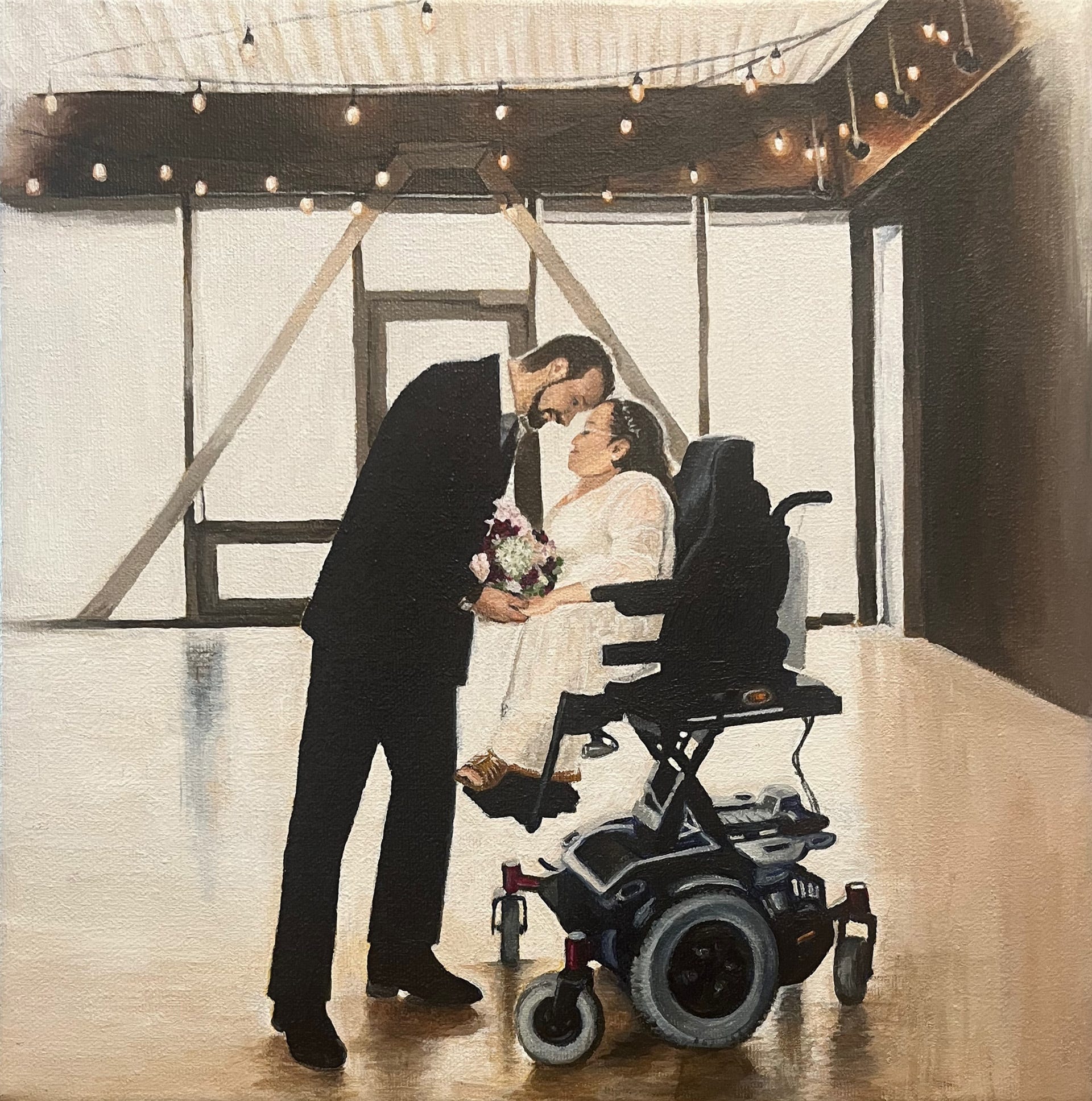
I also decided not to linger with it any longer than necessary. I didn’t need to be perfect; it only needed to be finished.
Plus, I had really not anticipated the emotional blowback, and that seemed a good enough reason to leave well enough alone once I got to the point of diminishing returns.
Final Thoughts
I have wrestled with grief around a path not taken before. It was back in 2004 when I was hit by a car at a crosswalk. That recovery had been comparatively easy with a cracked hip and a month and a half in bed.
Still, for years and years, I believed that accident had cost me the dream of working professionally as an animator.
What eventually helped me past that was realizing everything that I had gained.
If I hadn’t gotten hit by the car, I would have never had the settlement that became the down payment for my first condo.
If I didn’t own my condo, I wouldn’t have been able to adopt a dog—Lola.
If I had become an animator, I would have been hustling from contract to contract and never had the kind of steady salaried jobs in tech that I did.
If I hadn’t had the steady salaried jobs, I wouldn’t have had time to think about finding a partner. I would never have met my husband.
I don’t know if enough years have passed for me to do a similar thought experiment with my hospital stay, but I do not doubt that eventually I will be able to connect similar dots to all the things that matter to me most.
When that happens, I’m sure new layers of meaning will get added to “Rising Together”.
Athena is an artist, writer and creativity coach who believes that anyone can benefit from a healthy creative practice.
This beautifully written narration of the honest processing of grief and progress resonates in places I was purposefully ignoring. Thank you for sharing in such an honest way. We can't go backwards but oh, do we try!
Wow. Thank you for sharing this. Sometimes you just need to step back and take another look at something to see what you could not before. Things that were so important once maybe have lost a bit of that importance over time. Keep on keeping on, Athena! You rock.